The Bengal Files: OTT vs Theatre

I recently rewatched The Bengal Files on OTT with my family, after having seen it twice in theatres.

Guys, there is a big difference from the theatrical version - runtime.
The theatrical cut was 3 hours 20 minutes long, while the OTT version is just under 3 hours - a good 20 minutes shorter.
This tells me that Vivek Agnihotri takes feedback seriously.
He is clearly willing to revisit his own work and improve it. Trimming 20 minutes from such a dense film is not easy, and in many places the changes genuinely make the film tighter. The trimming definitely helped the pacing.
That said, I feel not every removal was needed, and the most important addition is still missing.
What Was Cut – And Whether It Worked
The Opening Partition Decision Scene (~4 mins)
The entire opening sequence showing Mountbatten getting ready for the big meeting, followed by the roundtable where Nehru, Jinnah, Patel, and others sit and finalize Partition, has been removed.
The idea was to show that Partition was decided by a few people sitting around a small table. While symbolically strong, I agree this was not strictly needed and the film works well without it.
In fact, you will notice that most historical scenes behind the decision of Partition have been removed.
Jinnah–Gandhi Interaction (~2 mins)

The Jinnah–Gandhi interaction on the two-nation theory has been made more crisp. One entire “sitting down” portion is gone.
This works well; the scene now flows faster without losing meaning.
Post “We the People” Scene (~5 mins)

After Mithun’s “We the People” scene/dialogue, the part where the missing girl’s classmate goes to investigate, and the scene where the present-day protagonist (the CBI officer) vents to old Bharati, have been removed.
I agree with this change. It felt repetitive, and since we already knew what was happening, there was no need for an investigation sequence or more explanation of the officer’s frustration.
Roy Chowdhary’s Death (~2 mins)
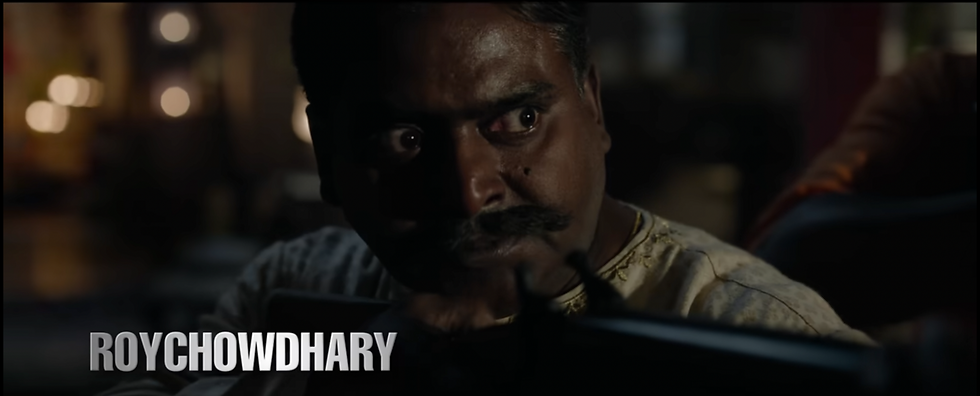
A small part of the scene where Noakhali’s main leader, Roy Chowdhury, and his people are massacred has been removed—the interaction of the lead pair with villagers and how they leave just moments before the killing platoon led by Ghulam arrives.
I feel this was unnecessary to remove, because it added tension and helped us empathize with the lead pair, making the loss feel more personal. However, I understand it did not add much to the main plot, so I reluctantly accept the cut.
Gandhi–Mountbatten Meeting & Jinnah Scene (~5 mins)

The scene where Gandhi meets Mountbatten and is told about the decision of Partition—with tears in Gandhi’s eyes while he is on maun vrat—has been removed. So has the sequence that followed: Jinnah’s interview and the confrontation by a Muslim journalist.
In the theatrical cut, these scenes together worked as a powerful commentary on the hollowness of Jinnah’s demands and the tragic, pyrrhic nature of Gandhi’s “victory” over the British.
In my opinion, removing the Jinnah–journalist scene weakens the film. Gandhi’s removal is acceptable, but the Muslim journalist questioning Jinnah - exposing political contradiction and hypocrisy - deserved to stay.
Muslim Classmate Girl’s POV (~3 mins)

The scene where the Muslim classmate is confronted again to help find the missing Gita has been cut. It was strong, but its removal makes sense.
I think the director sometimes added more of what he wanted to say than what the story needed. This scene felt like it existed mainly to “add” a Muslim perspective rather than serve the narrative.
Confrontation Between CBI Head and Protagonist (~3 mins)

The conversation between the CBI head and the hero was originally 10 minutes long and is now about 7 minutes.
This is one of the best edits. The repetition - especially where the CBI head repeats Mithun’s “We the People” dialogue - has been removed, making it much crisper.
I remember getting irritated by this scene in theatres. This time, I was pleasantly surprised.
I even told my family, “Now the film will start dragging,” but it didn’t - and that is when I decided to write this piece.
The Gory & Poetic Amar Death Scene (~30 seconds)

The brutal climax scene, where Amar is split in half, dragged, and thrown into the fire while Nehru’s speech plays in the background, has been removed.
I think this was a mistake. Yes, it is disturbing - but it was extremely powerful. I was shocked by the visuals and impressed by the writing at the same time.
The Ending Problem

The climax did not work for me.
I understand why the protagonist kills the MLA and the philosophy behind it. But what bothered me was this: how does the officer escape after killing such a powerful man? That is not shown.
Instead, the film cuts directly to him riding his bike to Bharati’s home.
I remember my friend and I getting annoyed in the theatre at the implausibility of it.
Suddenly, the film stopped making sense. The abruptness was very off-putting.
A small tweak could have fixed this.
After killing the MLA, a few shots of him placing the body on a bed or table—making it look like a brain stroke - and calmly telling the goons, “Sahab is asleep,” before walking out, would have made it believable.
Right now, the climax feels like angry vigilantism - impossible and out of place.
Before I proceed further, here are two brilliant moments from the film
One-take shot

The single-shot sequence during Direct Action Day, with Bharati running through chaos, is outstanding.
It deserves more praise. Zee Studios should release it officially or share its making for film students.
Dinner Scene with MLA

This scene brilliantly exposes how secular politics hides behind victim narratives. Here, the writer Vivek Agnihotri truly shines.
So why did the film not work at the box office? Not because of politics—something else failed.
The Roar of Patha

That actor who played Gopal Patha (the man who led the Hindu pushback) stole the limelight for me - his dialogue before his pratighaat. It suddenly wakes you up to not feel helpless anymore.
However, the intensity of his conversation with Gandhi, who keeps on like a tape recorder about Ahimsa during World War and communal riots, boils your blood but also shows the same Patha's intense emotional reaction with a tinge of helplessness.
Brilliant! Gopal Patha's sequence deserves to be on YouTube for the whole world to see!
Key Observations on the style
I loved the film and the trilogy. More than anything, I love the philosophy behind making this trilogy.
Vivek Agnihotri once even liked my tweet about making it a connected universe by bringing in Buddha in a Traffic Jam characters. But since he uses the same actors repeatedly, that was never really possible.
He is a great storyteller and a very experienced filmmaker. But as a lover of fine cinema, here are some patterns I have noticed in his work.
Language
He uses a lot of English in his dialogues, which I personally don’t like. But I understand why - he writes naturally and does not polish dialogues for mass taste.
In this film, when Amar is introduced, his dialogue feels too modern - like he is from Noida, not 1947. Examples:
“Tujhe SAD hone ka haq nahi hai”
“Rona dhona HANDLE nahi kar sakta main”
English words could have been avoided in many places. This happens even in The Kashmir Files. Some English is fine - but this film had too much.
Also, Amar’s entry needed more context. We jump straight into his philosophy. We only later learn he served in World War II. That makes his character feel incomplete.

Camera Work
There are too many handheld shots and too few tight close-ups.
In Mithun’s opening scene where he shows his cut tongue, a stronger close-up would have created more drama.
This is not spoon-feeding - it is cinema.
Agnihotri might be slowly falling into the “Anurag Kashyap indie” trap.Dhurandhar, though very different, uses drama effectively.
Sometimes Agnihotri under-dramatizes moments that deserve more cinematic weight.
Amateurish Moments
Some careless mistakes:
Geeta on video call opens the door and screams - who is recording when the phone is in her hand?
In the scene where eagles feed on corpses, one child on a “dead” body starts moving his hand and peeling off makeup. That broke the moment.

Repetition from The Kashmir Files
“Toote hue log bolte nahi, unhe suna jaata hai”
Woman paraded semi-naked in the climax
Both are repeated from The Kashmir Files and feel like emotional recycling.
Why The Bengal Files failed? Missteps in Marketing
Agnihotri was far better prepared this time. He even had a booklet with historical backing for every dialogue.
But journalists discussed very little about scenes, making it feel like the film was just “Kashmir Files in Bengal.”
The trailer-launch controversy diverted attention from the film to the filmmaker.

He was right to fight - but he should have done it after release. His reaction, though justified, looked bad to a neutral audience and shifted focus from the film’s message.
The tragedy of eastern India in 1947 got overshadowed by controversy.
Final Thoughts
The OTT version of The Bengal Files is sharper, tighter, and more watchable.
Most edits improve pacing, but a few powerful scenes—especially the journalist–Jinnah confrontation and Amar’s execution—should never have been removed.
Still, the changes are mostly a good move.
I hope more people watch this film after reading this.


Comments